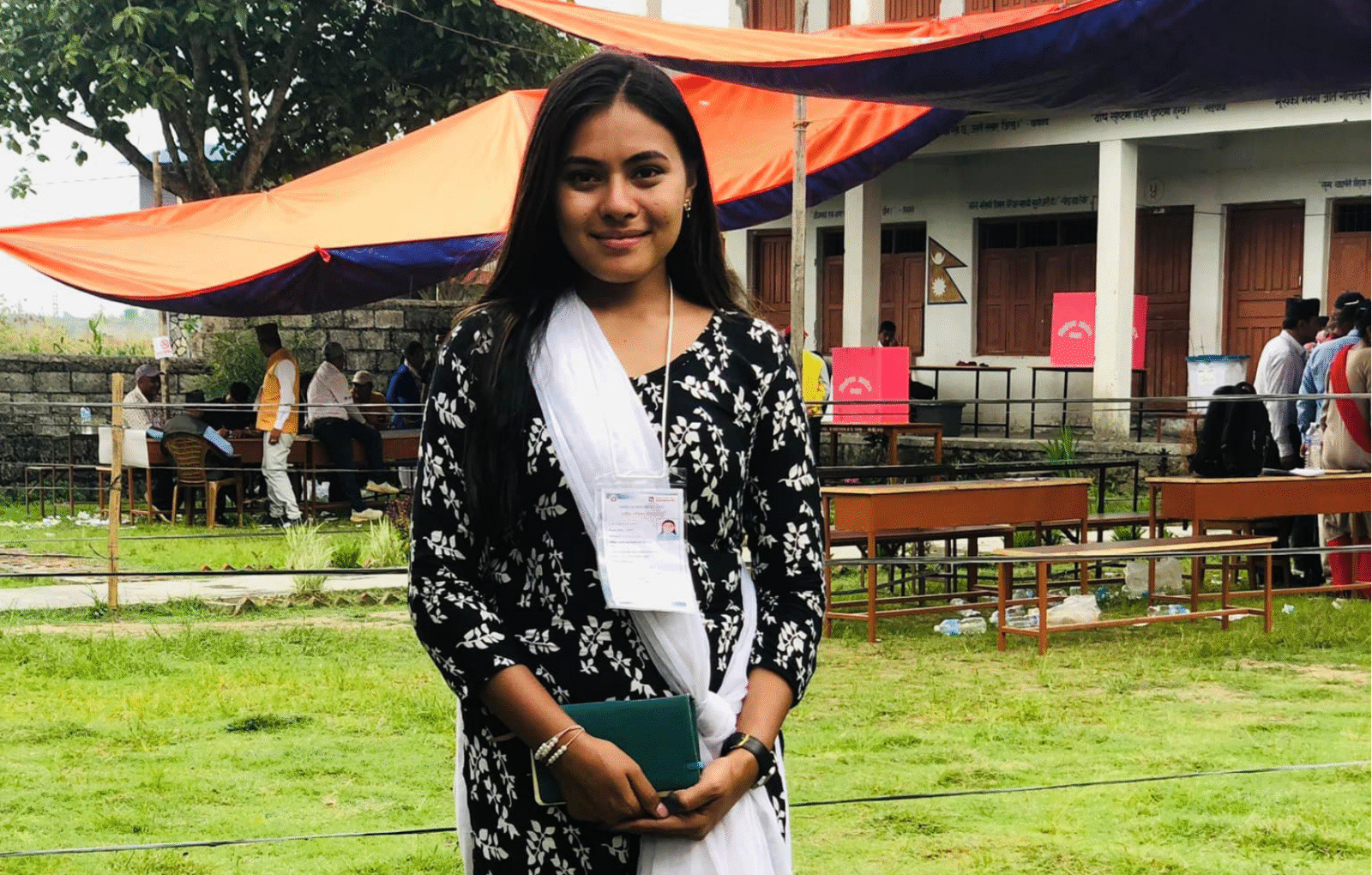
Monika Ranabhat, Diaspora Youth Intern at EUDiF, reflects on following Nepal’s elections from abroad and explores what it means to remain politically engaged without the ability to vote.
On election day in Nepal, my phone rarely stayed quiet. WhatsApp groups were full of updates; friends were sharing early turnout numbers and news websites were constantly refreshing with results from across the country. Despite living thousands of kilometres away, I followed the election closely; I discussed which candidate was leading on which constituency with family, friends and colleagues and tried to understand what the outcome might mean for Nepal’s political future. Being my first time following the election from a distance and having worked as a Youth Election Observer during the 2022 elections, I found myself following every detail even more attentively.
This election felt particularly significant for many young Nepalis because it came after the recent GenZ-led civic movement that mobilised many young people to speak more openly about political accountability and democratic participation. As someone from the same generation, following the election from abroad felt even more meaningful: I was not only following the results but also reflecting on whether the energy and expectations of my generation would be reflected in Nepal’s political future. For many members of the Nepali diaspora like me, elections remain moments of strong emotional connection and seeing that made me realize the distance does not necessarily weaken political interest; in some cases, it can even intensify it.
Reading Diana’s letter to diaspora voters made me reflect on this connection in a slightly different way. She highlights the importance of voting as a way for diaspora communities to stay connected and shape their country’s future, drawing on her own experience of participating in voting from abroad. While this is the reality for some diasporas, it is not possible for a lot of us to vote from abroad. In fact, based on my experience, those of us without the right to vote may follow elections even more closely, despite – or perhaps because of – the impediment to actually voting.
This creates a quiet paradox: even though I stay informed and engaged in political discussions, my role stops short of formal participation. To me, this experience feels like voting without voting.
As a Nepali living abroad and studying political science these moments feel particularly personal to me. Beyond my academics, I remain involved in diaspora initiatives that aim to maintain connections between Nepali communities abroad and developments at home. Through my internship with the EU Global Diaspora Facility (EUDiF), I also explore how different countries design diaspora initiatives and policies to engage their citizens abroad. These experiences have made me think more deeply about how diaspora communities participate in democratic life.
Experiences like this are not unique to me. According to International Organization for Migration, in 2026 more than 300 million people are international migrants, yet many remain closely connected to political developments back home. People often live, study and work across boarders while maintaining strong political and social ties with their countries of origin.
Yet this engagement does not always translate into formal political participation. In Nepal, for example, an estimated 2.2 million live abroad. The Constitution of Nepal (2015) guarantees the right to vote to all Nepali citizens, and in 2018 the Supreme Court directed the government to make arrangements for external voting, yet a functioning mechanism for remote voting has yet to materialise. As a result, many Nepalis living abroad cannot vote.
Beyond elections, Nepali diaspora communities continue to contribute to national development in different ways, including through remittances, fundraising during crises, youth-led advocacy, promoting civic education and raising awareness on issues affecting Nepalis at home and abroad. These forms of engagement show that political participation is broader than voting alone.
Many countries have taken steps to formally include their citizens abroad in their political system. Today, more than 90 countries around the world allow external voting for their diaspora citizens. The Philippines, for instance has enabled overseas voting through both in-person and postal options. Mexico allows its citizens abroad to vote in presidential elections and Italy even reserves dedicated parliamentary seats for its diaspora. These examples demonstrate there are different ways to facilitate diaspora political participation and voting.
Seeing how actively diaspora people in my network and on social media engaged with the election reminded me how strong our connection to home is. Even without a ballot, we continue to care, discuss and reflect on the direction of Nepal, as do so many diaspora communities without voting rights.
As migration continues to shape societies around the world, democracies may need to rethink how participation is defined. When citizens live across boarders but remain deeply connected to their home countries, political belonging cannot be limited to geography alone. Recognising diaspora participation including through voting rights, can make democratic systems more inclusive and representative by ensuring that citizens who remain invested in their country’s future are not excluded from its political processes. This can also encourage deeper engagement from diaspora communities, strengthening their willingness to contribute, stay connected and in some cases even return or invest in their home country.
For Nepal, acknowledging the political engagement of its diaspora would not only honour the lived reality of millions of citizens abroad but also strengthen the country’s democratic fabric. With a significant proportion of its young population living abroad, Nepal could further leverage the potential of its diaspora by creating more inclusive mechanisms such as voting rights. Until democratic systems fully adapt to this transnational reality, many diaspora citizens will continue to experience elections in the same way I did, watching closely, caring deeply, voting without voting.
Monika joined EUDiF as a Diaspora Youth Intern for the period March–July 2026. However, her time with us was cut short as she was accepted into the International Politics PhD programme at the University of Passau with a Hanns Seidel Scholarship. While we are saddened to see her go so soon, we are very excited about the research she will undertake on Nepal’s federalism implementation from 2015-2025. We wish her the very best in this endeavour and thank her for her contributions during this very industrious month working together.