© Humboldt-Stiftung/David Ausserhofer
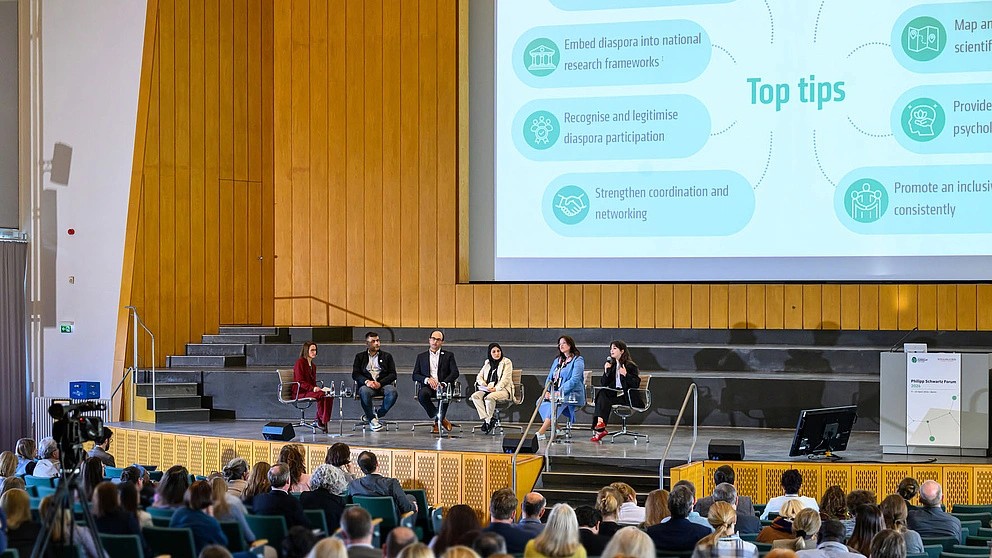
EUDiF Junior Project Officer Liza Bezvershenko reflects on the role of diasporas in reconstruction and recovery inspired by recent exchanges with diaspora representatives, including those held during the Philipp Schwartz Forum 2026 on 9-10 April in Berlin.
Oksana, a young architect from Ivano-Frankivsk, Ukraine, has been living and building her career in the Netherlands since 2017. When Russia invaded Ukraine in 2022, she started reaching out to her professional community – fellow architects, urban planners and designers – to engage them in an informal creative school for newly arrived Ukrainian teenagers. In these sessions, they reflected on rebuilding the country, what kind of cities the children wish to return to and what they would want to rebuild to realise their dreams. Her initiative was about more than discovering a potential future career; the workshops had an underlying healing purpose – collectively exploring the meaning of home, which for many had been physically lost.
In an increasingly volatile world, where global wars, political crises and natural disasters devastate cities and societies, the topic of reconstruction has become increasingly prominent on the international agenda. Reconstruction, in this context, refers to a long-term, comprehensive and coordinated process of rebuilding physical infrastructure, as well as restoring governance, economic, social systems and collective well-being. Diasporas – whether long-established or newly arrived – have repeatedly been recognised as important actors in planning reconstruction and recovery efforts by national and international stakeholders. From Ukraine to Rwanda, from Venezuela to Myanmar, diasporas have contributed to the recovery of their countries and societies despite the physical distance of thousands of kilometres and, in some cases, ongoing unsafety. As mapped in EUDiF’s practice collection on reconstruction and recovery, such engagement is truly a global observation spread through all continents.
What makes diasporas a crucial link in reconstruction?
Besides the usual benefits of transnational position of diasporas, associated with knowledge of internal-external contexts, networks and language, the reconstruction-specific arguments for diaspora-led engagement are the following:
- Diaspora engagement is often driven not only by ‘financial returns’, but also by ‘emotional and social returns’, shifting the focus from ‘having more’ to ‘being more’. Their motivation and sense of responsibility extend toward both their known and imagined (distant) communities, with a strong orientation towards long-term social and political transformation.
- While international actors play an important role, their interventions may sometimes reinforce inequalities or be perceived as externally driven, culturally distant or aligned with geopolitical or economic interests. Funding structures are often asymmetrical and may not fully reflect the needs of affected communities.
- Diaspora-led initiatives can contribute to the systematic transformation by addressing historical inequalities and persistent drivers of conflict. Their proximity to lived experience – combined with physical distance – often brings greater sensitivity and empathy.
- Diasporas shift reconstruction away from externally driven interventions towards stronger ‘home-grown’ ownership. Their contributions go beyond physical rebuilding to more complex areas such as democracy, justice, policy development, mental health, and collective memory.
- While reconstructive efforts are often associated with rebuilding from scratch what has been lost and introducing new knowledge, diasporas can better navigate the balance between bringing new ideas and preserving local history, culture and traditions.
What do diasporas do?
After the immediate crisis response, described in detail in the report “Diaspora engagement in times of crisis”, diasporas often enter in a transitional period before recovery: reconstruction. Besides traditional ways of contributing – such as sending remittances or supporting key economic and investment sectors – diasporas take on non-traditional, yet natural, tasks:
Infrastructure revival and urban planning. Through their international exposure to often more developed countries, diaspora communities contribute not only to rebuilding, but to “building back better”. They introduce green technologies and technological innovation, increasing the resilience of spaces around them. Being exposed to best international practices, diasporas are well positioned to identify needs and solutions quickly. This includes engaging diaspora architects, urban planners and engineers in physical and sustainable reconstruction.
Political and governmental engagement. Even from abroad, diasporas participate in political processes and transformations in their countries of origin – elections, policy reforms, democratisation and anti-corruption efforts. They contribute to policy development, research and act as watchdogs holding their governments accountable. Many return to work in public structures, helping fill capacity gaps and strengthening institutions.
Social cohesion and inclusion. Diaspora groups initiate social cohesion initiatives through facilitating public dialogues, raising difficult societal issues both at home and abroad. They foster inclusion by supporting the most vulnerable groups, such as children, youth, women and veterans. Through EUDiF projects in Lebanon, Iraq and Somalia, diaspora is contributing to the development of opportunities for skills development for vulnerable youth. In contexts where women’s rights are restricted, diasporas (often women) provide digital and in-person support to those in the country.
Justice and accountability. Having fled conflict, many diaspora members collect testimonies, document war crimes and engage with international actors to raise attention and seek accountability. They contribute to documenting abuses, advocating for justice and supporting collective memory and reconciliation efforts.
Education and skills transfer. Diaspora expertise strengthens national education systems by training professionals, supporting scholars and building digital and technical skills among youth. They help improve curricula (as in the DP4D action in Ethiopia), mentor teachers and university staff and guide young people through their educational and early career paths, as described in the Learning by doing: Education and vocational training.
Health and mental health. Diaspora professionals often lead initiatives focused on psychological support, trauma care and development of mental health systems, drawing from their direct experience. As discussed with Jin Dawod, a representative of the Syrian diaspora and founder of the online psychological support platform Peace Therapist, building inner peace eventually builds healthier communities that will lead healthier countries.
These areas are not exhaustive; diaspora communities may find many other ways to contribute to long-term recovery. For more information and inspiration, visit our practice collection on reconstruction and recovery. Disclaimer: the practices included are gathered through EUDiF’s annual global mapping, network knowledge and desk research. If you would like to propose an initiative to be featured, please contact us at eu-diaspora@icmpd.org.
Ecosystem of hidden constraints
Nevertheless, this transnational position comes with certain challenges that may hinder diasporas’ participation in reconstruction processes:
Limited funding and investment. Diaspora organisations often rely on volunteers and in-kind contributions. Funding mechanisms remain inflexible, and diaspora actors are often overlooked by both home and host country systems, leaving them in a “blind spot” for funders.
Weak government support and limited coordination. Countries, especially those recovering from crisis or war, often need to adapt their government systems to new realities and emerging needs. Limited resources and institutional capacity can complicate coordination with their diasporas, especially for international projects. These constraints may be compounded by political hurdles, governance weaknesses, persecution, corruption or sanctions.
Ongoing instability and physical unsafety. Continued conflict may push external donors to prioritise urgent humanitarian aid over long-term sustainable initiatives. Ongoing military actions increase immediate needs and decrease the capacity and enabling environment for social projects in education, health and other sectors. This blocks both institutional and societal reconstruction.
Legal and administrative barriers. Restrictions related to voting rights, dual citizenship and freedom of movement can limit diaspora engagement. As well, administrative constraints in the host country may affect individuals and their families, reducing the overall ability to contribute to reconstruction, while prioritising integration.
Trust deficits and insider-outsider tensions. Diaspora actors may be perceived as distant or “external”, leading to reduced legitimacy, access and influence. Fragmentation, as described in the Venezuelan context, within diaspora communities may feed identity-based stigma and marginalisation and increase sensitivities, especially in conflict and crisis contexts.
The building blocks for diaspora engagement
Even though diaspora actors are known for their strong motivation and emotional commitment to their countries’ prosperity, enabling conditions are essential for long-term and sustainable interventions. Flexible, rapid and long-term financial and technical support should be paired with the freedom to design context-responsive reconstruction projects.
Engaging diasporas inclusively – not only women and youth, but also people from under-represented communities, remote and rural areas, diverse religious and social backgrounds – at the project design stage directly contributes to equal and democratic reconstruction that responds to the needs of populations both inside and outside the country. An inclusive approach strengthens social cohesion, which is necessary for societal reconciliation and healing.
Tailored psychological support is also necessary to help diaspora members cope with trauma and difficult feelings associated with displacement (such as survivor’s guilt).
Regular and continuous platforms for engagement at national and international levels are crucial for increasing diaspora visibility and legitimacy. These spaces allow success stories to be highlighted and shared, helping build trust, improve public perception and structure the evolving role of diaspora in reconstruction.