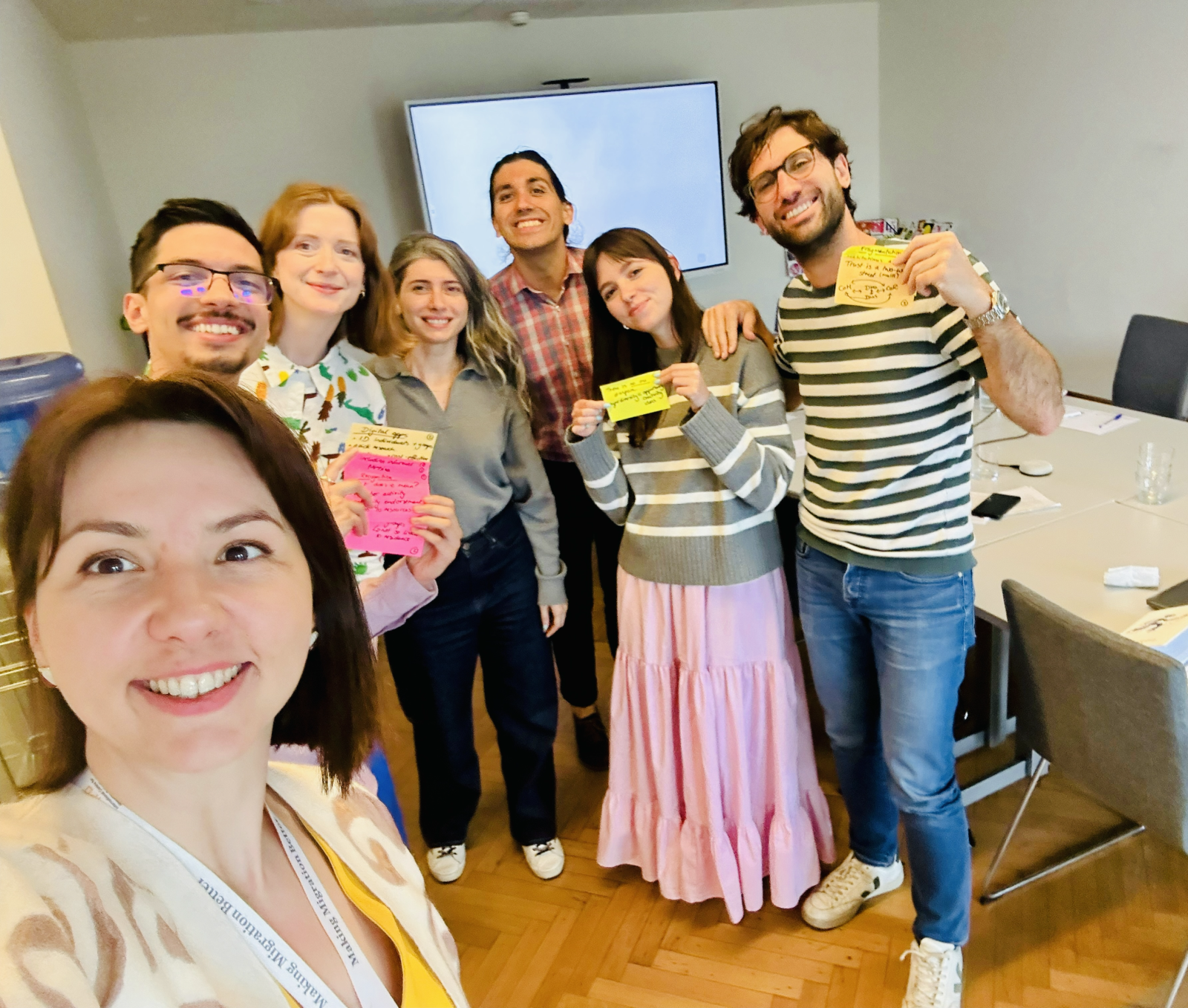
Fresh from completing his Bachelor’s degree in Global Studies, diaspora youth intern Julio reflects on the final moments of his academic journey—marked by his thesis on the Venezuelan diaspora in Spain and a workshop with the EUDiF team and a Venezuelan diaspora expert—offering a unique moment of reflexivity on diaspora engagement in the Venezuelan context.
What is it like to belong to a diaspora and study it at the same time?
When lived experience meets academic curiosity, the result is a powerful lens on identity, belonging, and engagement.
Having the opportunity of executing my research on the Venezuela diaspora and being able to present it as a workshop in a project such as EUDiF, where global diaspora engagement is the main topic, was nothing but a dream come true. One year ago, I would have never imagined, even in my wildest dreams, that I would achieve this, at least in the early stages of my professional career.
Sometimes, I wonder if I am being too tunnel-visioned (and even a bit too much) when I talk about the situation in Venezuela, and my migration journey. But in my reality, it needs to be discussed more! A country in which a third of its population lives outside their motherland and, despite not being the largest country, has the biggest diaspora in Latin America and one of the largest five globally. Isn’t it a “wow” worthy reaction? And yours truly belongs to this group of 9 million people.
The political trauma caused by Venezuela’s authoritarian regime has made the history of its diaspora particularly complex. It stands in contrast to the idealised notion of a diaspora—one that actively engages with the country of origin, connects meaningfully with the host country, contributes to development back home, and sustains the hope of one day returning to what was once called “home.”
The challenges faced by the Venezuelan diaspora also extend to its diaspora organisations (DOs), which are often diverse, underfunded, and operate informally. As the Venezuelan diaspora expert Tomas Paez, who kindly joined my EUDiF workshop put it: “These organisations not only provide services to Venezuelans arriving in specific cities; they also engage in public diplomacy and even construct a geopolitical alternative to the Venezuelan government’s strategy.” This highlights the remarkable resilience of these DOs, which, despite limited resources, play a dual role: supporting diaspora communities while also filling the diplomatic void left by the current authoritarian regime in Venezuela.
Re-thinking labels
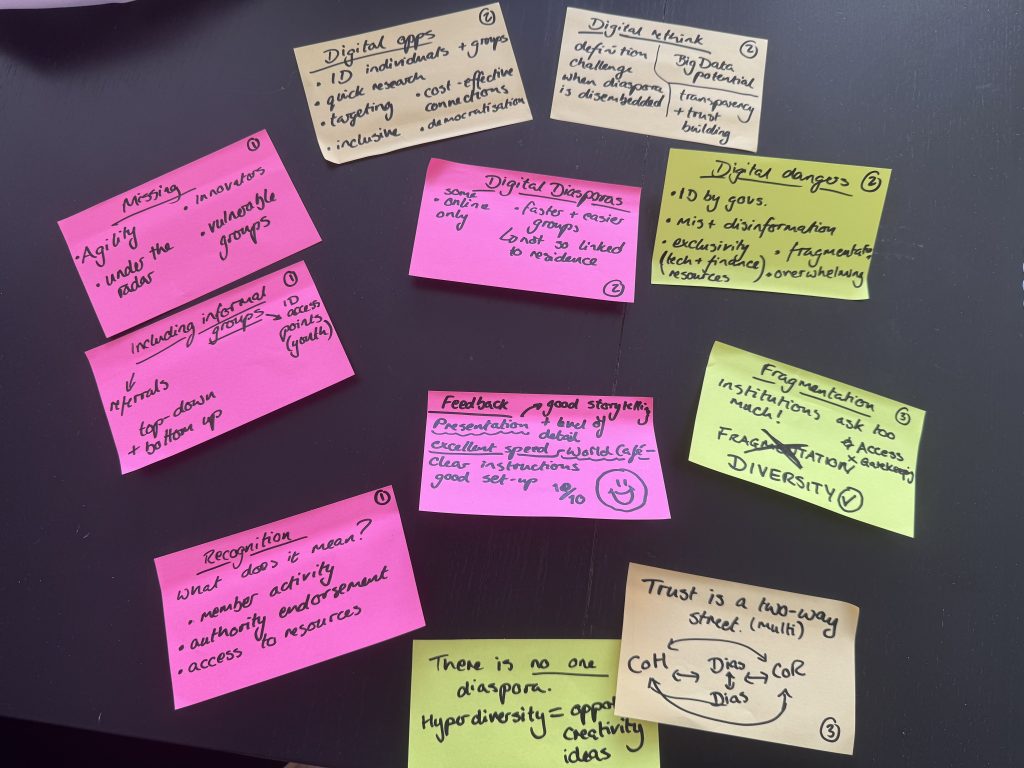
As the title of this piece suggests, two key concepts emerged throughout my research and the workshop discussions: fragmentation and hyperdiversity.
Fragmentation refers to the multiple, sometimes disconnected realities within the diaspora, shaped by cultural, socioeconomic, and political differences. These divisions often reflect the complex and uneven nature of the Venezuelan diaspora experience.
However, in the workshop, the word hyperdiversity came up, and it challenged this fragmentation framing. Instead of seeing this complex landscape as problematic and framed negatively, seeing it as an opportunity to “accept the diaspora landscape as it is” as a participant mentioned during the workshop.
Although what does it mean to “accept” this reality, and how can we engage with complex diasporas such as the Venezuelan? Especially from an international organisation’s perspective. In an ideal world, everyone would receive help from entities capable of providing support in different aspects, but it is not as simple as that. It never is. It requires organisation, legitimacy, and most importantly, trust.
The invisible infrastructure
“Trust should be the new currency,” one participant remarked. But trust in whom? Within the diaspora itself? Between diaspora organisations, NGOs, and public institutions?
The diasporic landscape involves multiple actors, each requiring a degree of trust to function meaningfully. Without it, very little can move forward. Of course, trust doesn’t emerge in a vacuum. No one wants to trust without some form of guarantee. There must be a threshold of willingness to take risks.
But what about those actors who, due to their disadvantaged position, struggle to offer that sense of security? This is the case for much of the Venezuelan diaspora, which lacks formal diaspora governance or support from its country of origin. In such contexts, building trust becomes both essential and deeply challenging.
Digital diasporas
One of the most striking findings in my research was the central role those digital platforms—especially social media—play for many Venezuelan diaspora actors. Instagram, Facebook, WhatsApp, and Telegram were the primary tools used to connect, organise, and share information. In fact, I was able to continue navigating this digital ecosystem largely thanks to Instagram’s suggested accounts algorithm.
Bringing this up during the workshop sparked mixed reactions: on one hand, there was a growing recognition that social media does matter for diaspora engagement. On the other hand, concerns were raised about the risks these platforms can pose, especially in the age of rapidly advancing AI. Cybersecurity becomes a crucial issue when vulnerable communities are involved.
As the Venezuelan diaspora expert pointed out, many DOs operate with minimal funding and simply cannot afford to build or maintain official websites or domains. Social media, therefore, becomes the default—accessible, immediate, and free. What surprised me most was the level of engagement these actors managed to sustain despite such limitations. From promoting job opportunities and coordinating remittances to organising cultural events across Spain, the digital Venezuelan diaspora is not only alive, it’s active, creative, and resilient.
Beyond the institutional framework
The making of this entire project has been a journey marked by deep reflexivity, particularly around my positionality as both a researcher and a member of the very population I was studying. My time at EUDiF was truly meaningful. Working alongside and learning from different diasporas around the world prompted me to reflect on my own relationship with Venezuela, my country of heritage.
For years, hearing the word “Venezuela” evoked conflicted emotions—resentment, sadness, and unresolved feelings tied to political trauma. There was little room left for joyful thoughts or nostalgic memories. But something shifted during this experience. Now, every time Venezuela is mentioned—whether at work or elsewhere, I light up with excitement. I feel a growing sense of pride in seeing my country gain visibility in spaces that matter.
Moving forward, I carry that visibility with me. I’ve learned how to reconnect with my roots in a way that honors my identity, while also detaching that connection from the regime that forced so many of us to leave. It’s not about forgetting the pain but about reclaiming the narrative.
Being able to carry out this project and to see it exceed my expectations has been incredibly fulfilling. I feel proud to have introduced a new layer to the conversation: reflection. Through this, I invited participants to consider diasporic actors who fall outside traditional institutional frameworks, while also emphasizing the importance of safety for everyone involved in these processes.
The aim of this piece is precisely to invite reflection. To offer a window into my lens, my journey through this project, and my time at EUDiF. As my internship draws to a close, I take with me not only the lessons I’ve learned, but also the sense of belonging EUDiF cultivates—once you join, you remain part of the community, a friend and family member for life. I look forward to the next chapter with pride in my Venezuelan identity, ready to carry it forward and represent it wherever I go.