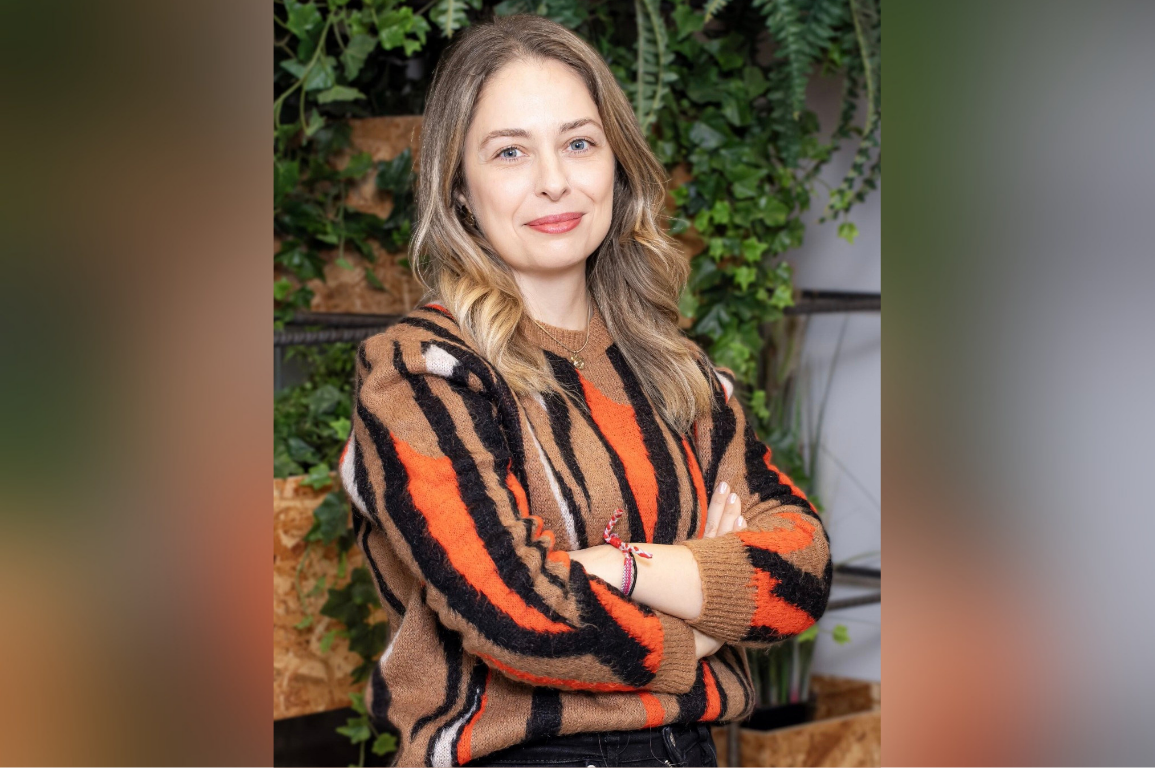
With a personal story shaped by a rich and complex cultural heritage, and a career dedicated to human rights and social inclusion, Deniz Torcu, Executive Director at IE Business school currently researching European identity through the lens of diaspora, multilingualism, and transnational narratives reflects on the permanent negotiation of identity and belonging. Speaking with Diaspora Youth Intern, Zeline Dennis, she explores the importance of shifting the understanding on identity in Europe and the role that education can play in that change.
Zeline: How does your identity and migration journey shape your interest in researching diaspora?
Deniz: I did not come to this research through theory. I came to it through customs desks; residence permits and the strange experience of being asked where I am really from in every language I speak. Migration runs through my family like a watermark. My heritage traces back to Georgia, my grandparents were among the guest workers who moved to Germany in the sixties, and I was born and raised in Turkey carrying all those stories with me. I then built my own path between Turkey, France and later Spain, and have now lived in Madrid for over a decade, working in higher education and raising a family here.
So, when I say diaspora is personal to me, I mean it across generations. I grew up hearing what it meant to build a life in a country that saw you as temporary, and decades later I found myself asking whether the questions had really changed that much. Somewhere along that journey I realised that the question of identity never actually resolves itself. You do not wake up one day feeling finished. What changes is your relationship with the question.
That is what drew me to research diaspora. I wanted to understand something I was living, why identity for people like me works less like a destination and more like a permanent negotiation. Stuart Hall captured this beautifully when he described identity as a production, something never complete, always in process. Academia gave me the language and the frameworks for something I had been experiencing intuitively for years, and once I found that language, I knew this was the work I wanted to do.
Z: Why is it important to better understand diasporic identity and belonging in today’s global context?
D: Because the number of people living between two or more worlds keeps growing, while our institutions still tend to treat belonging as binary. You are either from here or from there, either you are either integrated or you are not. That framing was never accurate, but today it is actively harmful, feeding a political narrative in which complexity is treated as a threat and simplification is rewarded.
Avtar Brah gave us the useful concept of diaspora space, the idea that diaspora does not only concern those who migrated but transforms the entire society where migration happens, including those who never moved at all. That is the shift in perspective we need. Diasporic identity is one of the most sophisticated social phenomena of our time. People who carry more than one culture are constantly translating, mediating and bridging, often invisibly. They hold networks that span borders, they move knowledge and trust between societies that otherwise struggle to communicate, and they do this while being asked, again and again, to prove they belong. Understanding how that works is not a niche academic interest. It is essential knowledge for any society that wants to remain open, competitive and cohesive at the same time.
Z: What does your research on European identities and its interaction with diasporas contribute to understanding diaspora’s role and engagement across borders?
D: My research looks at how European identity has historically been constructed in dialogue, and often in tension, with the people it defines as outsiders. I work with the idea, inspired by thinkers like Étienne Balibar, that borders are not just lines on a map. They are conditions people carry inside them, reproduced in institutions, in social interactions, in the everyday question of who is seen as belonging and who is not.
What this contributes, I hope, is a shift in how we think about diaspora engagement. If borders live inside societies rather than at their edges, then diaspora communities are not standing outside Europe knocking on the door. They are already inside the story, shaping it, and they always have been. Their engagement across borders is not an anomaly to be managed but a preview of how identity and citizenship will work for more and more people. Europe has always been made and remade through movement. Recognising that is not a concession to diasporas. It is simply a more honest reading of European history, and a more useful one for its future.
Z: As someone with a background in culture and teaching, how do you see education shaping diasporic perception and engagement?
D: Education is where a society quietly tells you whether you belong. Long before any policy document, a classroom communicates whose stories count, whose references are considered universal, and whose are treated as exotic additions. I have spent years teaching in international classrooms, and I see every day how students from diasporic backgrounds arrive with an extraordinary skill set that the system rarely names as such: they read rooms across cultures, they switch registers, they hold multiple perspectives at once. Too often, institutions treat that as background noise rather than talent.
At the same time, education is also where diasporic engagement gets activated. When a curriculum takes cultural complexity seriously, when institutions make room for students to bring their whole trajectory into the room, something shifts. Students stop performing a simplified version of themselves and start contributing from the full breadth of who they are. My experience in cultural diplomacy taught me the same lesson at the level of institutions and governments: culture and education are where perceptions are formed, and therefore where they can be changed. If we want diaspora communities to engage, the work starts with how we educate everyone, not only the diasporic students themselves.
Z: Why does this conversation matter in today’s European conjuncture?
D: Because the timing is not neutral. Anti-immigration sentiment is rising across Europe, and with it comes a narrative that flattens millions of individual stories into a single figure of threat. In that climate, talking about diasporic identity is not an academic exercise. It is a way of insisting on complexity at a moment when complexity is under attack.
And the irony is that the data tells exactly the opposite story to the one dominating public debate. According to the European Commission, people born outside the EU now make up 12.6 percent of the Union’s working-age population, and since the pandemic, employment growth in the EU has been driven primarily by workers born outside it.
These are the people keeping sectors with chronic labour shortages running. At the global level, migrants sent nearly 700 billion dollars in remittances to low- and middle-income countries in 2024, according to World Bank and UN estimates, more than foreign direct investment and development assistance combined. Diaspora communities are, quite literally, one of the largest development mechanisms on the planet, and they run it out of their own pockets.
But the economic case, as powerful as it is, is only the entry point. Diaspora communities connect societies, they move knowledge and trust across borders that governments struggle to bridge, and they enrich the cultural and intellectual life of their host countries. They do all of this while navigating a public conversation that increasingly questions their place. The cost of getting this wrong is enormous, and not only for diasporas themselves.