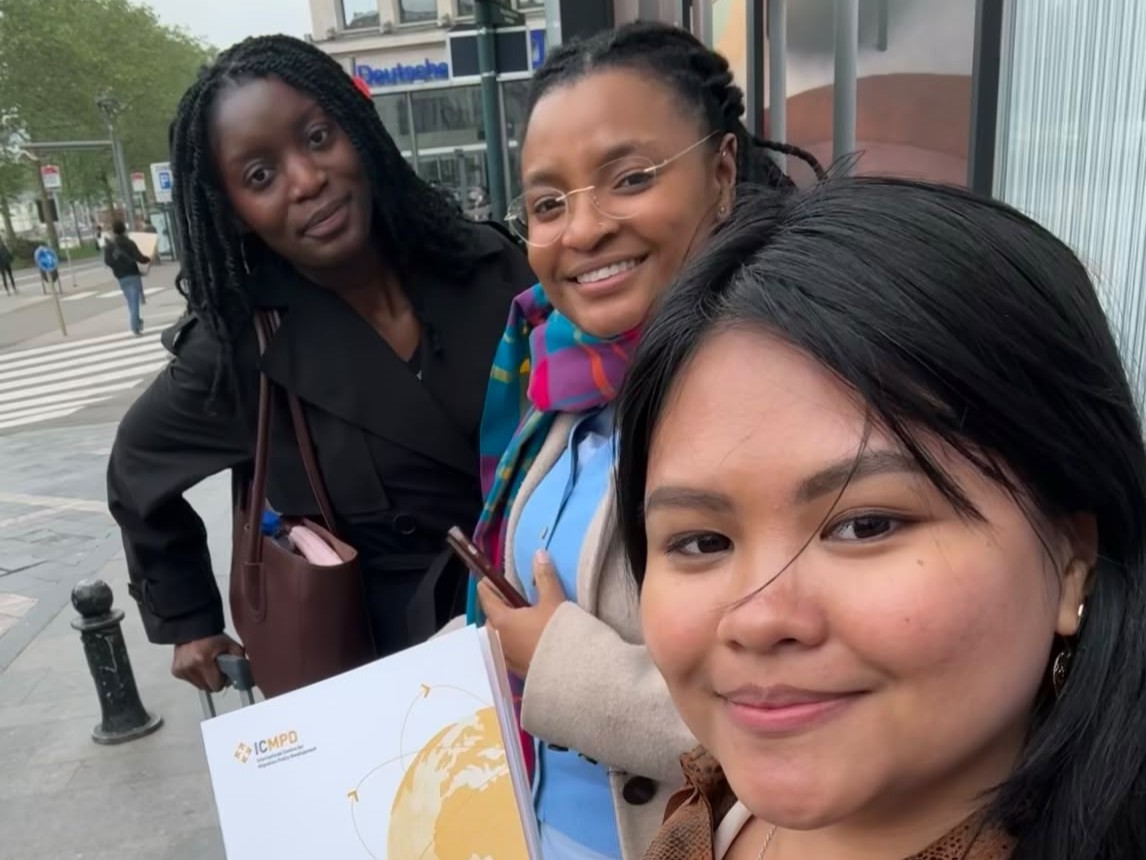
Meet EUDiF’s newest diaspora youth interns, Mary Otieno and Zeline Dennis as they reflect together with Nicole Ulanday on identity, belonging and life across cultures. In this conversation, they share how their personal diaspora experiences inspire their work and perspectives on migration and development.
Would you prefer reading the interview? You can do so below.
Nicole: Magandang umaga! Bonjour! So, I just greeted you good morning in my mother tongue, Filipino, and in French, because I’m currently speaking to you while enjoying the sun from la ville rose, or the pink city of Toulouse in France.
I thought, hmm, this might be a nice way to start our very first podcast as diaspora youth interns here at EUDiF, by greeting each other “hello” in our mother tongues, and then in the language of where we’re currently based.
So, hi, Zéline and Mary! And for our listeners, Zéline and Mary are EUDiF’s newest diaspora interns. Would you like to give it a try as well?
Zéline: Lumela! Dia Duit!
Mary: Habari! Buongiorno!
Nicole: Oh, lovely! Okay, let me try that too. Lumela! Dia Duit! Habari! Buongiorno! Did I get that right? Hopefully I didn’t butcher it!
So, for today’s podcast, we really just want to get to know you both a bit more, your diasporic identities, your stories, your paths to EUDiF, and, you know, everything in between. But before that, I just wanted to start with something simple.
We first met in person during our work visit in Brussels about a month ago, and honestly, it was just so nice finally meeting everyone, spending that whole week together.
So I’m curious, how have you both been since then? And looking back on your first month, what has surprised or maybe even excited you the most about being part of EUDiF?
Zéline: Being a part of EUDiF has been a great experience so far. It’s been amazing to see how such a relatively small team has had so much impact in so many countries around the world. Learning about all the projects and seeing how each person has played their own role in the success and completion of the projects has been nothing short of inspiring. It goes to show that you don’t need very large teams to make things work, just individuals that are passionate about the work they are doing.
Nicole: I totally agree with you on that Zéline that impact doesn’t always depend on size. How about you, Mary?
Mary: What has excited me the most has been how welcoming and diverse the EUDiF team is. We started our internship with a trip to Brussels, where we met the whole team and spent the first week together and got to know everyone. One of the highlights was our team trip to Antwerp and the visit to the Red Star Line Museum, which offered a powerful perspective on migration and mobility. For me, it was a reminder of how migration stories connect people across borders, and it made me even more excited to be part of an initiative that places diaspora experiences at the centre of its work.
Nicole: Yeah, the team dynamic really stood out. The Red Star Line Museum was also definitely a highlight for me. The museum really captured that sense of courage and movement. And I think, in different ways, we can relate to those journeys as part of the diaspora. So, speaking of that, how would you describe your relationship with the idea of “home”?
Zéline: Hmmm. I have often pondered over that question a lot. I grew up in Lesotho, and I have lived in a few countries over the past couple of years, so home is an abstract concept to me right now. Lesotho will always be my home but I guess I would have to go with the cliche saying , that home is not just the place , it’s the people you feel safe around, its family and friends. I am home when I am with the people I care about no matter where I am.
Mary: For me home is a word I think about a lot. Being from Kenya and living in Italy, I sometimes feel that I belong to both places in different ways. Kenya is where I come from and where many of my memories are rooted, while Italy is where I am building a life and creating new experiences. Over time, I have come to realize that home does not always have to be one place; it can exist across borders. In a way, I feel that I carry pieces of home with me wherever I go.
Nicole: Wow, I love that: home as something you carry with people and experiences. So, has living in Europe changed how you think about your identity?
Zéline: Yes, I’m more aware of who I am and who I represent. Lesotho is a small country and very few people have ever heard of it, so I am always excited to showcase a bit of my culture in the different spaces that I occupy.
Nicole: What about you, Mary?
Mary: I think so, being away from Kenya has made me value my culture and roots even more, but at the same time, living in Italy has exposed me to new perspectives and experiences. I have learnt to embrace all these different influences because they’ve shaped who I am today.
Nicole: That makes sense, especially representing your culture more consciously. Now, I want to ask you both something else relevant to these experiences and now this experience that we are all having together: what drew you both to EUDiF?
Zéline: The other side of migration. I have researched and read repeatedly on migration challenges, its negative impacts and all its downfalls. I was interested to work in an environment that focused mainly on the positive side of migration and how diaspora have contributed to host and origin countries. Diaspora engagement is an integral part to the development of countries, and it excites me to be able to be given the opportunity to explore that and also showcase that to a wider audience. Seeing as I am also part of the diaspora, it hits a little closer to home.
Nicole: Wow, that just brought me back to our taxi conversation in Brussels when we landed there last month, Zéline! I clearly remember you talking about your research and I’m glad that this interest is now integrated in your work. Mary?
Mary: Honestly, what really drew me to EUDiF was the fact that I am part of the diaspora myself. I’ve experienced firsthand what it means to navigate different cultures and communities, so the idea of working on diaspora and development really resonated with me. I was also excited by the opportunity to learn from people with different experiences and to contribute to conversations that highlight the positive role that diaspora communities play.
Nicole: I think that the common denominator is indeed the positive side of migration. And yes, that personal connection really comes through. Now, let’s flip the coin over. What do you think people often misunderstand about African diasporas?
Zéline: Unfortunately the media has often portrayed emigration from the continent in a negative light. For a continent that is so rich in culture and diversity, I think more light needs to be shed on the stories, innovation, and advancements made by the African diaspora and what positive roles they play in the various spaces that they occupy abroad.
Nicole: Right, the common narratives often focus too much on challenges.
Mary: I think people sometimes forget just how diverse the African diaspora is. Our cultures, languages, and stories are incredibly diverse, and even people from the same country can have very different experiences. I think there’s often a tendency to focus only on the challenges, when African diaspora communities have so much to offer and play an important role in connecting people, ideas, and opportunities across borders.
Nicole: And the diversity within the diaspora is often overlooked. But I am so glad that these words are now out there coming from the members of the African diaspora such as yourselves. Thank you for all these. I am just sitting here listening to you but I am learning a lot of things. Given that, how about you two, what are you hoping to learn from each other?
Zéline: I’m excited to learn more about her perspectives on being a part of the African Diaspora and the various lessons she’s picked up along the way whilst living abroad.
Mary: I’m excited to learn from each other’s experiences. We come from different countries and are living in different parts of Europe, so I’m curious to hear how those experiences have shaped our perspectives.
Nicole: Wonderful! That exchange of perspectives will be really valuable. Well, this has been such a meaningful conversation. Thank you both for sharing your stories and reflections so openly. I think what really stands out is how, even across different countries and experiences, there are so many shared threads in what it means to be part of a diaspora. And to our listeners, we hope this conversation gave you a glimpse on ways mobility, identity and belonging can take shape across borders. So, thank you for tuning in to this very first podcast by EUDiF’s Diaspora Youth Interns. We’re really excited for what’s ahead and perhaps, for more conversations, podcasts might I say, like this. Until next time!