
EUDiF and Dr. Claire Vincent Mory mapped how over 300 organisations describe themselves and identified the elements that most frequently underpin their diaspora identity…
Since EUDiF’s inception in 2019, the definition of diaspora has come up time and again, especially in our dialogue activities, from diaspora consultations in 2019 to each edition of the Future Forum from 2020 through 2025. We have explored it further in research papers like the Starting guide: What is a diaspora organisation? and reflections such as Defining diaspora, a never-ending story.
It’s not just us: policymakers, practitioners and academics from across the ecosystem have suggested and adopted various definitions of diaspora and diaspora organisations. Yet, all definitions have limitations and caveats, including our own:
“[diaspora organisations are] organisations managed by diaspora members and/or having a majority of diaspora membership. Diaspora organisations should be based outside the country of origin and their activities can be implemented in regions, countries or communities of origin and/or host countries. Diaspora organisations can carry out a wide range of activities, depending on their purpose, including with a strong focus on integration activities, development activities or both simultaneously.”
So this time, EUDiF took a different approach: rather than asking how diaspora organisations should be defined, we asked how they define themselves.
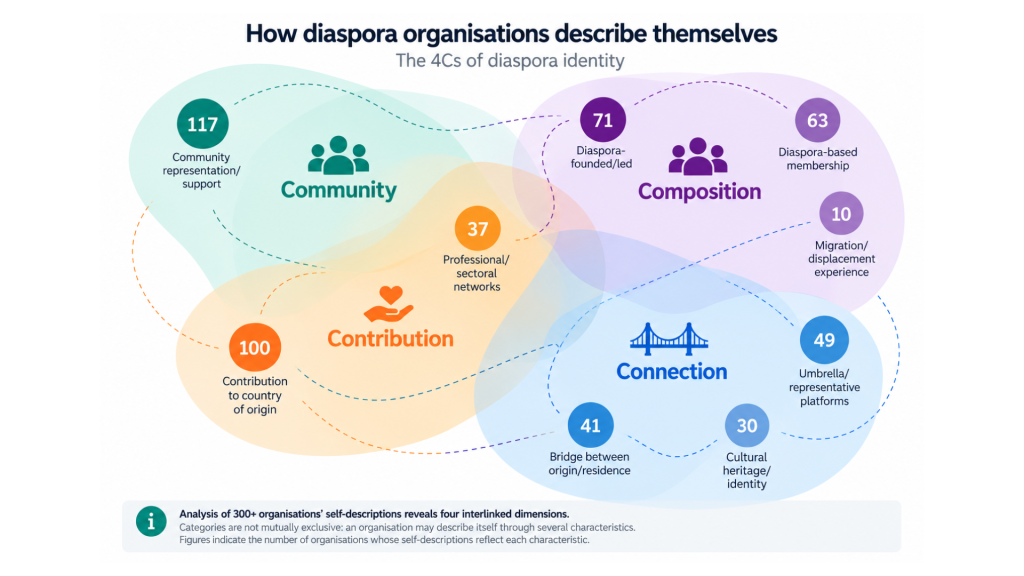
Together with Dr. Claire Vincent-Mory, a Marie Skłodowska-Curie postdoctoral fellow at the Centre for Ethnic and Migration Studies (CEDEM) of the University of Liège, we mapped how more than 300 organisations describe themselves. As Claire continues her research, EUDiF used the preliminary dataset to group the organisations’ definitions into four overlapping categories (diaspora organisations often refer to more than one characteristic in their definition):
- Community
- Contribution
- Composition
- Connection
Community, the strongest thread
Community representation and support appear in 117 organisational descriptions, more than any other category. Organisations often describe themselves in relation to the people and communities they exist to support. These descriptions suggest that diaspora identity is not simply about being part of a diaspora but about representing, supporting or organising around a community.
For instance, the Organisation of Sierra Leoneans in Sweden acts “for all Sierra Leoneans in Sweden”. Asociación de Cooperación Bolivia – España similarly emphasises it connection to the Bolivian community, explaining that they support Bolivians in Spain and in Bolivia: “We were born as the Bolivia-Spain ACOBE Cooperation Association in April 2004, with the aim of supporting the migrant population, mostly of Bolivian origin […] and training for the return of immigrants and/or to consolidate their resettlement in the country of origin.”
Contribution to the homeland
The second most frequent characteristic is contribution to the country of origin, appearing in 100 descriptions. This is particularly visible among organisations that mobilise professional knowledge and expertise. The Afghan Medical Staff Association, for instance, describes itself as an association of German and Afghan medical professionals in Germany whose projects “contribute to the development and modernisation of the health care system in Afghanistan.”
In these cases, diaspora identity is expressed through action. Organisations connect expertise, resources and networks acquired in one place with needs and opportunities in another. This transnational dimension also appears explicitly in 41 descriptions that present the organisation as a bridge between countries of origin and residence.
Composition – leaders and members
How an organisation began and is constituted remains an important part of diaspora identity. Seventy-one organisations refer to being diaspora-founded or diaspora-led, while 63 refer to diaspora-based membership. For example, the Angolan Professional Network describes itself as a network founded by young Angolan professionals residing in the Netherlands. Similarly, Danaker identifies as a diaspora-led organisation founded by young migrant women from Kyrgyzstan in Poland.
Ten organisations explicitly connect their definition to an experience of migration, return, refuge or displacement. Activados Panama, for example, describes itself as “a foundation led by migrants and refugees”. The Advocacy Network Against Irregular Migration identifies itself as “founded by returned migrants.”
However, the findings suggest that leadership and membership are only part of the picture. They sit alongside, and frequently overlap with, descriptions based on community, transnational engagement, expertise, culture and contribution to countries of origin.
Connection – networks, expertise and culture
Forty-nine organisations described themselves as an umbrella, network or representative platform, showing another way in which diaspora identity is built collectively. Others organised around shared professional expertise. Thirty-seven descriptions corresponded to a professional or sectoral diaspora network, bringing together doctors, entrepreneurs, academics and other specialists around both a common professional identity and a diaspora connection.
Culture and heritage also matter. Thirty organisations rooted their identity in cultural heritage and identity. The Arab German Centre for Dialogue (WASLA) states that “WASLA means connection, a relationship in which a person, thing, or idea is linked or associated with something else. […] The key factors that act as the internal motor for sustainable development are creativity and culture”. The Ibn Battuta Foundation defines itself as “a non-profit organisation dedicated to the cultural and social dissemination of Arab countries and Europe”.
What does this mean for defining diaspora organisations?
The categories of definitions overlap. An organisation may be founded by diaspora members, represent a particular community, mobilise professional expertise and contribute to its country of origin, all at the same time. Another may understand its diaspora identity primarily through migration experience and the community it supports. A third may see itself above all as a bridge or representative network.
Coming back to EUDiF’s working definition, the findings do not point towards replacing it with a new one. Instead, they add a bottom-up perspective grounded in how organisations describe themselves. Whilst the findings show alignment with core elements of EUDiF’s definition, particularly in terms of organisational composition and the role of connecting countries of origin and residence, the community dimension stands out more strongly. Over a third of organisations define themselves by the communities they represent, bring together or serve. This suggests that who the organisation sees itself as representing is an important part of diaspora organisational identity.
The relative importance of these dimensions may depend on the purpose of the definition. A funder determining eligibility, a government identifying representative interlocutors, a researcher mapping diaspora actors and an organisation describing its own identity may each place different weight on composition, community, contribution or connection. Rather than establishing a fixed hierarchy, the findings therefore highlight the value of looking across these dimensions when asking what makes an organisation a diaspora organisation.