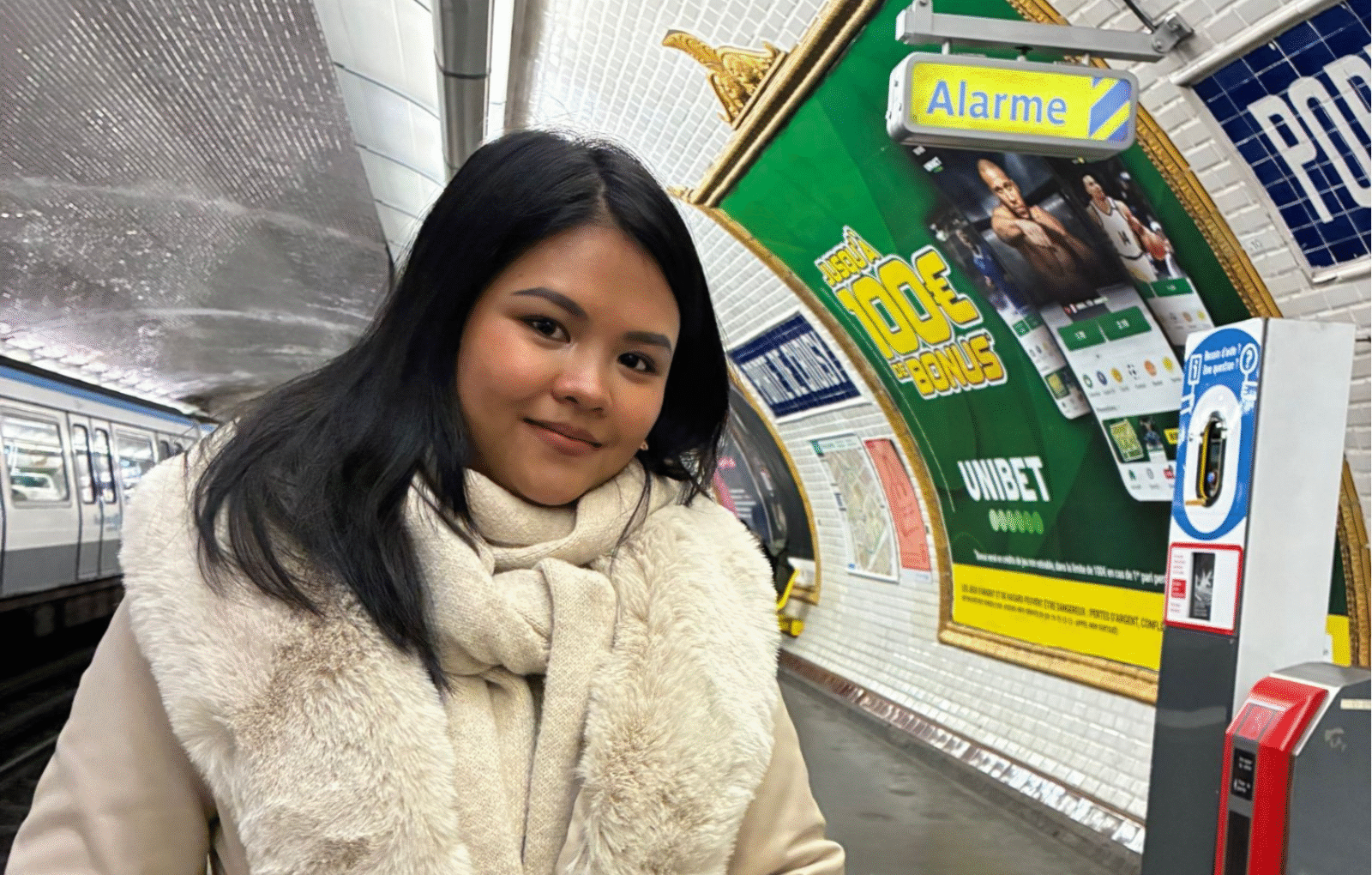
Drawing on her lived and academic experience, Nicole Ulanday, EUDiF’s newest Diaspora Youth Intern, highlights the importance of food in community-building within the Filipino diaspora and how to best amplify stories that reflect diaspora experiences.
Picture this: a sweltering Sunday birthday celebration. A group of men sit around a table on the sidewalk, drinking Red Horse (a Filipino beer brand) and sharing sisig as pulutan (snacks and small dishes eaten while drinking alcohol); a woman belts out a Whitney Houston classic at the karaoke machine while her friends wait their turn or flip through the songbook; kids play in the street; neighbours and relatives leave with food containers or aluminium foil packed with food to take home, a phenomenon we jokingly call being a Sharon.
If you are not familiar with this scene, let me tell you what it is: a perfectly imperfect image of a typical party in the Philippines.
This culture, fortunately, transcends borders.
So when Agustín and Hala asked how I maintain my diasporic identity during my interview, my answer came instantly: Filipino food. While I do cook, the meals I buy from or share with my kababayans (compatriots) in Toulouse, where I am currently based, hold more power in strengthening that identity. To me, it is beyond taste or familiarity because through those meals, connections are built and my sense of home is recreated through cooking, sharing and gathering.
Fieldwork amongst Pinays in Toulouse
In la ville rose (the pink city), Filipinos gather either as a whole community or in smaller groups formed over time. In the association Amitié Franco-Philippine en Midi-Pyrénées (AFPMP), there are currently 200 registered Filipino members, according to its president, Jimmy Ong. While this is small compared to other French cities, we form a close-knit community. It is here that I study anthropology and conduct research on Filipinas—Pinays, as we call ourselves—who sell home-cooked Filipino meals.
For four months, I travelled across neighbourhoods in and around Toulouse to interview these Pinays. They are also the same women who bring meals, often for free, to AFPMP events or get-togethers I had the chance to attend. For some, their business began when a kababayan tasted something they brought to a dinner and later asked them to cook it again, this time for pay. For most, however, it grew out of necessity.
To appropriately talk about them, I have opted for providing each of them a pseudonym in my thesis. But instead of conventional names, I chose Filipino adjectives that, to me, best represent the spirit of the Pinays I met during our conversations, for instance: Matapang (brave), for a Pinay whose courage was evident in the way she spoke about her experience in her workplace; Madiskarte (strategic), for another who carefully walked me through the strategies behind her small food business; Matatag (strong) for someone who steadfastly endured obstacles and scrutinies that came her way when she set up many small-scale businesses trying to generate more income for her ill mother in the Philippines.
When I asked Matapang for an interview, she invited me over one weekend, saying there would be kababayans at her home and that we could talk after dinner. I did not expect a full house. Our interview became something like a talk show, with everyone watching, listening and reacting. I still listen to the recording from time to time. I ask questions, she answers, and in the background there is laughter, teasing and commentary. It brings me back to the streets of the Philippines: noisy, lively, chaotic if you will, but that is the sound of home.
True to being a Caviteña (someone from the province of Cavite), Matapang talked about her work experience fiercely. She had this sharpness, defiance even, in her voice when talking about how she refused to be belittled at work as a migrant. And when she was sharing those moments, it was certain she was doing so not to complain but instead, as assertions. To me, she embodied bravery in the way she chose to speak about it.
What was meant to be a one-hour interview with Madiskarte extended into four. She enthusiastically shared the technical details of running a food business, recalling how rising food prices in the Philippines pushed her to improvise like stretching one egg between two servings of tapsilog, a traditional Filipino breakfast meal. She continues to apply these strategies in Toulouse, now expanding into decorative cakes with Filipino flavours like pandan and ube. In her kitchen, she has set up a small studio where her husband photographs her cakes for her Facebook page.
Matatag showed me how strength takes different forms. She ventured into multiple businesses while handling life as a new wife and mother, facing failures, scams and public scrutiny along the way. Our interview became emotional as she shared these experiences openly. Today, her business is one of the most established within the Filipino community in Toulouse. As I watched her chop vegetables for pancit, mix cassava cake batter, and check the pork belly lechon in the oven, all while speaking with me, I came to see that what she does is not just work, but something she knows by heart.
Being brave, strategic and strong seem to be shared traits amongst Pinay migrants. Leaving one’s country in search of better opportunities is an act of bravery, even more so when it continues for many years. At the same time, they constantly find ways to earn additional income beyond their main jobs as femme de chambre or femme de ménage (housemaid) so they can send more money home. These strategies, and the resilience behind them, are shared during gatherings, often over food and karaoke.
After these interviews that to me felt more like kwentuhan (chitchat), I found myself becoming a Sharon too, taking home food containers filled with food that would last me days. In these exchanges, I was both a researcher and part of the same cycle of sharing and care.
This experience in the field has reshaped my understanding of migration, diaspora and community-building. Migration is multi‑faceted; each of these Pinays has a different story and trajectory, and there are myriads of ways they participate in the diaspora, keeping the ubiquity of home, far away from our homeland. It has also made me realise how strong the Filipino diaspora is.
Bridging research and practice
My research and diasporic identity are also what drew me to EUDiF. As a Diaspora Youth Intern in Communications, I will be working closely on D4D projects with fellow diaspora colleagues and for diaspora communities which is something I feel profoundly proud of. To me, EUDiF, and this internship in particular, extend both my identity as a Pinay in the diaspora and my anthropology work into a more practical, communicative space.
Over the next five months, I will write, communicate and create within a space that values both analysis and care. Anthropology, while a social science, is also affective. In the field, I listen, observe and share meals with my kababayans; now, I am tasked with writing and making sense of those encounters without losing their texture.
My work combines qualitative research and storytelling. How do I write about the noise of home I felt at Matapang’s dinner table? How do I translate Madiskarte’s step-by-step strategies into something readable yet grounded? How do I remain faithful to the weight of Matatag’s story? These are questions I continue to sit with.
In my first weeks at EUDiF, I have been joining calls with D4D grantees, listening to how diaspora-led projects are carried out in different contexts. In some ways, these conversations reflect what I have seen in Toulouse: initiatives built from care, resourcefulness and community ties. Whether through organised projects by AFPMP or home-cooked meals by Pinays, they are driven by the same impulse to create, sustain and connect to home.
In the months ahead, I hope to learn how to translate fieldwork into forms of communication that support diaspora communities, not only in Toulouse, but in other regions. I carry with me the stories, the meals and the spaces that made this research possible. Soon, I hope to share the results, as well.
I am excited to spend the next five months with EUDiF, and to grow alongside the team as we work with and for diaspora.
About the author
Nicole Ulanday is a first-year Master’s student in Anthropology at the University of Toulouse – Jean Jaurès. She earned her degrees in Creative Writing and Philippine Studies, majoring in History, from the University of the Philippines Diliman, where she received literary awards for her short stories in Filipino. Alongside her academic training, she has worked in communications as an intern for various organisations in the Philippines. During her time at Sciences Po Toulouse, where she pursued International and Comparative Studies, she also joined The Puzzle Asia, writing news and feature articles on Filipino migration.
Beginning in September 2026, she will join the Erasmus Mundus Migrations Transnationales (MITRA) program as a full scholarship recipient, studying across four universities over two years. Through this, she aims to develop a specialisation in migration and diaspora communications.