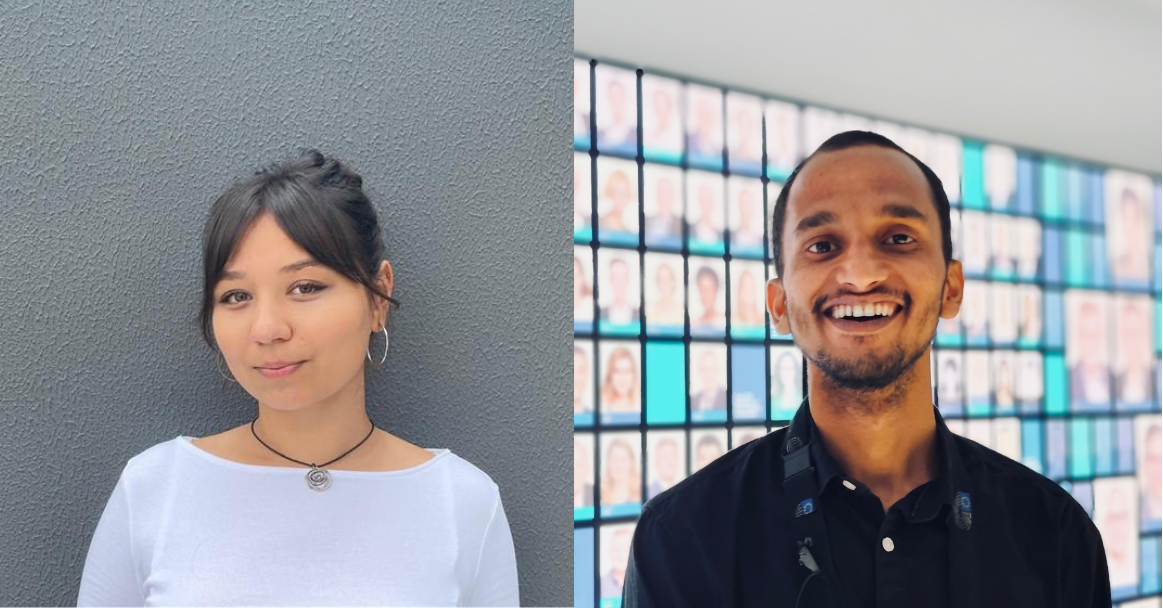
Our two new diaspora youth interns, Alya Honarpisheh and Farseen Puthanveettil, share their reflections on the role of community in diaspora engagement. Drawing on their own lived experiences, they discuss why community work matters, the challenges it faces, and how community-based approaches can make diaspora engagement more inclusive and impactful.
What first drew you personally to community work? Was there a particular experience that sparked your interest?
Alya Honarpisheh (AH): My identity as a diaspora member is shaped by my existence between two worlds and my close connection with the Iranian diaspora in the specific context of Germany. Especially as a second-generation member, I can use my identity to help build bridges between two worlds, both on cultural and institutional-political levels.
On the one hand, I seek to engage with my community with an open mind. On the other hand, I have taken the insights derived from these dialogues into institutional structures. Therefore, community work has helped me connect to my diaspora identity by, firstly, giving me the chance to connect, understand, and be understood; and secondly, by showing me how I can use my position to hopefully contribute to the community as a whole.
Farseen Puthanveettil (FP): I grew up in a community where a large part of the population is in the diaspora and remains continuously engaged with our region transnationally. Growing up, I saw directly the impact of their engagement: a water purifier in our school, a bus shelter, scholarships for children, a house built for a neighbour, palliative care services, free dialysis centers, and so many other initiatives. These experiences showed me how community work can bring meaningful changes.
Later, when I began studying social work, I realised that what I had witnessed was community work in practice; people coming together to identify needs, mobilize resources, and build systems of support (though not always in its professional form). It was this early exposure which inspired me to see community work as a natural path for myself.
From your perspective, why is community work important in the context of diaspora engagement?
AH: I believe that community work is central within the engagement of the diaspora, as it allows members of the diaspora to engage in conversations, exchange their experiences and negotiate their positions in an autonomous way. This, in turn, can create a network of trust and solidarity, fostering agency which can be then utilized to navigate challenges and to establish a shared vision for action. Thus, I believe that through the creation and fostering of a community, diaspora members can channel their perspectives into action and be empowered to act on their common understanding.
FP: Given diaspora members’ unique position – living between host and heritage countries – they face challenges that are often specific to them, and they are best placed to address those issues. Community work has significance in various contexts, but in the context of the diaspora, it provides a valuable means of addressing the distinct needs of members as well as their counterparts in countries of heritage. Community work focuses on building the capacity of community members to identify and address their own needs and I believe that such a participatory approach can enable professionals working with diaspora to design programmes that are contextually relevant and inclusive.
In your experience, what kinds of challenges arise when practicing community work in diaspora settings?
AH: The most evident challenges I have observed are twofold. Firstly, community work often takes place without the support of a broad institutional framework that could sustain the engagement. Diaspora members may encounter obstacles, for instance limited financial resources, which can make this work more difficult. Strengthening institutional support and recognition could, therefore, empower community leaders and help create spaces where communal initiatives can grow.
Secondly, I believe that community work is closely connected to the spatial aspect mentioned above. Diasporic third spaces can serve as both safe environments and important points of contact, yet such spaces are not always widely available or easily accessible. At the same time, creating accessible spaces can facilitate the exchange of knowledge and experiences. Since this spatial dimension is not always fully considered within institutions, it also presents an opportunity for further development and focus.
FP: Adding to Alya’s important points, I would like to highlight the nuances within diaspora populations that may make community work challenging. Unlike other community settings, where boundaries may feel solid and identities more easily contained, diasporic contexts are shaped by fluidity. This fluid nature makes it difficult to establish fixed frameworks within which to situate our engagements. We cannot rely on generic models of practice to navigate this shifting and complex dynamics of diasporic contexts. Instead, we need to bring in awareness, knowledge, and sensitivity so that our ways of engaging are most appropriate.
How can community-based approaches make diaspora engagement more inclusive and impactful?
AH: Community-based approaches can make diaspora engagement more inclusive by promoting and enabling projects and ideas that specifically come from within the community. This way it is more likely that institutional initiatives aimed at fostering diaspora engagement are more aligned with the specific needs of the diaspora members and their respective heritage countries. Additionally, it strengthens a bottom-up approach and makes members feel heard and empowered, leading to long-lasting networks between institutions and communities.
FP: As we discussed in response to another question earlier, a community-based approach places community members’ lived experience and expertise at the centre, while also allowing them to address their own challenges together with professionals who can support them in building needed capacities.
Each diaspora carries their own internal dynamics which is shaped by historical, cultural, and socio-political contexts from both their heritage and host countries. Without actively involving community members, engagement efforts may risk overlooking these nuances. By using a community-based approach, we can ensure that our programmes are inclusive and sensitive to the unique realities of the diaspora groups we serve.
About the authors:
Alya is half German and half Iranian but grew up in Germany with a close connection to Iranian culture and its diaspora. As a child, she visited her family in Iran and recently returned there for the first time in several years. Shortly before the start of this internship she earned her Bachelor of Science in International Relations and Organisations at Leiden University after spending a semester abroad in Istanbul, Turkey. In the following semester she is taking additional courses in International Law with a focus on Development. Since 2020 she has advocated for the rights of young refugees and the political engagement of diaspora members within various organisations.
Farseen was born and brought up in Kerala, a southern Indian state along the Arabian Sea. He holds two postgraduate degrees – one in Social Work and another through the Erasmus Mundus Joint Master’s programme in Migration and Intercultural Relations. His studies took him across Europe, where he lived in Germany, Belgium, the Czech Republic, and Norway. He is now based in Norway, where he completed his final semester and wrote his master’s thesis on the Indian diaspora in Norway. He previously coordinated a research project with a Keralite diaspora association and currently volunteers with a pan-EU diaspora collective.