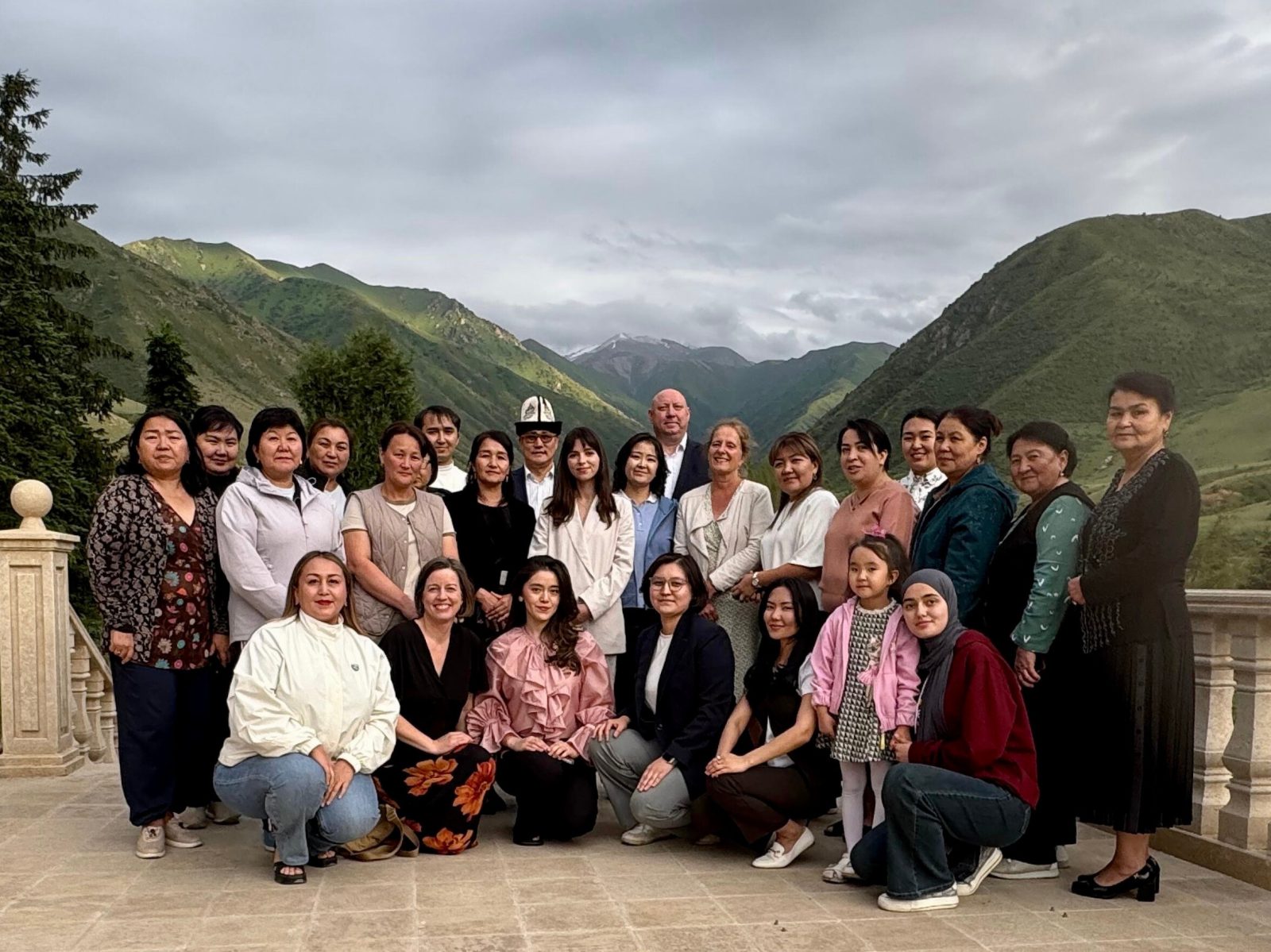
As part of the Capacity Development Lab project supporting the Migration and Human Trafficking Council (MHTC) of Kyrgyzstan, we conducted a six-day training on inclusive public dialogue (IPD) for 18 local community leaders to discuss the roles and rights of women in Kyrgyz society in collaboration with the Association DANAKER – Diaspora of Women from Kyrgyzstan in Poland (Danaker), and experts from the Nansen Centre for Peace and Dialogue in Norway.
In communities where tradition meets change, women’s voices still struggle to be heard. Women in Kyrgyzstan continue to face violence, stigma, and ongoing challenges in securing equal rights and opportunities at work and within their families.
To address these issues in a safe and open environment, the practice of the inclusive public dialogue was introduced in Kyrgyzstan as a pioneering initiative. Held in a picturesque mountain retreat, the training created an atmosphere of reflection, trust and self-discovery.
Local relevance and transformative impact
In Kyrgyzstan, patriarchal norms often limit open conversations about women’s rights. This gap was identified by diaspora experts and confirmed through needs assessments and focus groups conducted as part of the Kurak Voices project.
The participating local leaders highlighted the urgency of talking openly about such issues as early marriage, bride kidnapping, family roles, women’s safety and solidarity. The training was tailored to cover these local priorities, with participants taking the lead when choosing the topics most relevant for their communities.
This learning experience proved to be far more deeply transformative than any specific skill training. Many participants, especially women, shared that the sessions on deep listening and empathy would fundamentally change how they communicate with their families and colleagues.
Why dialogue matters
“A public dialogue is a facilitated dialogue for the public about a topic of public interest. This approach is particularly useful for addressing sensitive, conflicted, or controversial topics, where participants have space to share their personal stories and thoughts, and perhaps build trust and better understanding across differences,” – Nansen Centre for Peace and Dialogue
Unlike debates or discussions, dialogue is not about convincing or winning arguments. It focuses on listening, thoughtful questions and personal reflection. The goal is to understand and to find strength in the other. By creating a respectful and empathetic space, it encourages participants to explore their personal experiences, confront difficult emotions, and build bridges of understanding.
Though often met with initial hesitation in traditional societies, this method requires time and focuses on creating long-term impact. In inclusive public dialogue, the process matters more than the immediate outcome. By truly listening to one another, a deeper understanding is achieved, trust is built, and change begins to take root.
Enablers for change
To ensure an open and successful public dialogue training, there are several key enabling factors:
- Multidiversity: The 18 participants represented different genders, ages, professions, and religious backgrounds. From young entrepreneurs to experienced decision-makers, the wide range of views was reflected in one room.
- Immersive format and safe environment: The duration and structure of the training allowed for deep immersion and reflection. Even beyond the official sessions, conversations continued informally in the relaxed, nature-based setting, fostering genuine connection.
- Participant-driven content: Trainers focused on guiding the process, rather than the content. This allowed participants to identify the most pressing local issues, ensuring both relevance and resonance.
- Reflection of local identity: The practice of dialogue was linked to traditional Kyrgyz methods of collective conversation, such as those once held in yurts. By drawing these parallels, the training validated the local context and reconnected modern tools with cultural heritage.
Beyond the training room, inclusive public dialogue has potential as a transformative tool in broader policy and social advocacy. By providing a structured yet empathetic framework for dialogue, it allows communities to process trauma, confront taboos, build mutual understanding and foster local action.
For Kyrgyzstan, and potentially many other contexts where women’s voices are still fighting for space, this approach offers a culturally resonant, scalable, and deeply human path forward.
Next steps
To ensure sustainability and lasting change, trained participants were invited to plan their own public dialogue sessions with their local communities. With continued mentorship from DANAKER diaspora experts, the participants are encouraged to seek advice, share challenges, and support each other both online and offline.
The tailored Kurak Voices Toolkit serves as a practical guide, bridging theory with practice, and adapting international knowledge to the local context. Translated into three languages, it provides an inclusive foundation for future independent sessions.
EUDiF would like to thank the Migration and Human Trafficking Council under the Speaker of the Kyrgyz Republic’s Parliament (MHTC) and the Association DANAKER – Diaspora of Women from Kyrgyzstan in Poland (Danaker) for their warm welcome to Kyrgyzstan; Christiane Seehausen and Astrid Folkedal Kraidy for their insightful and compassionate training; and all local community leaders for their time and openness throughout this learning journey – your genuine engagement truly made a difference.